
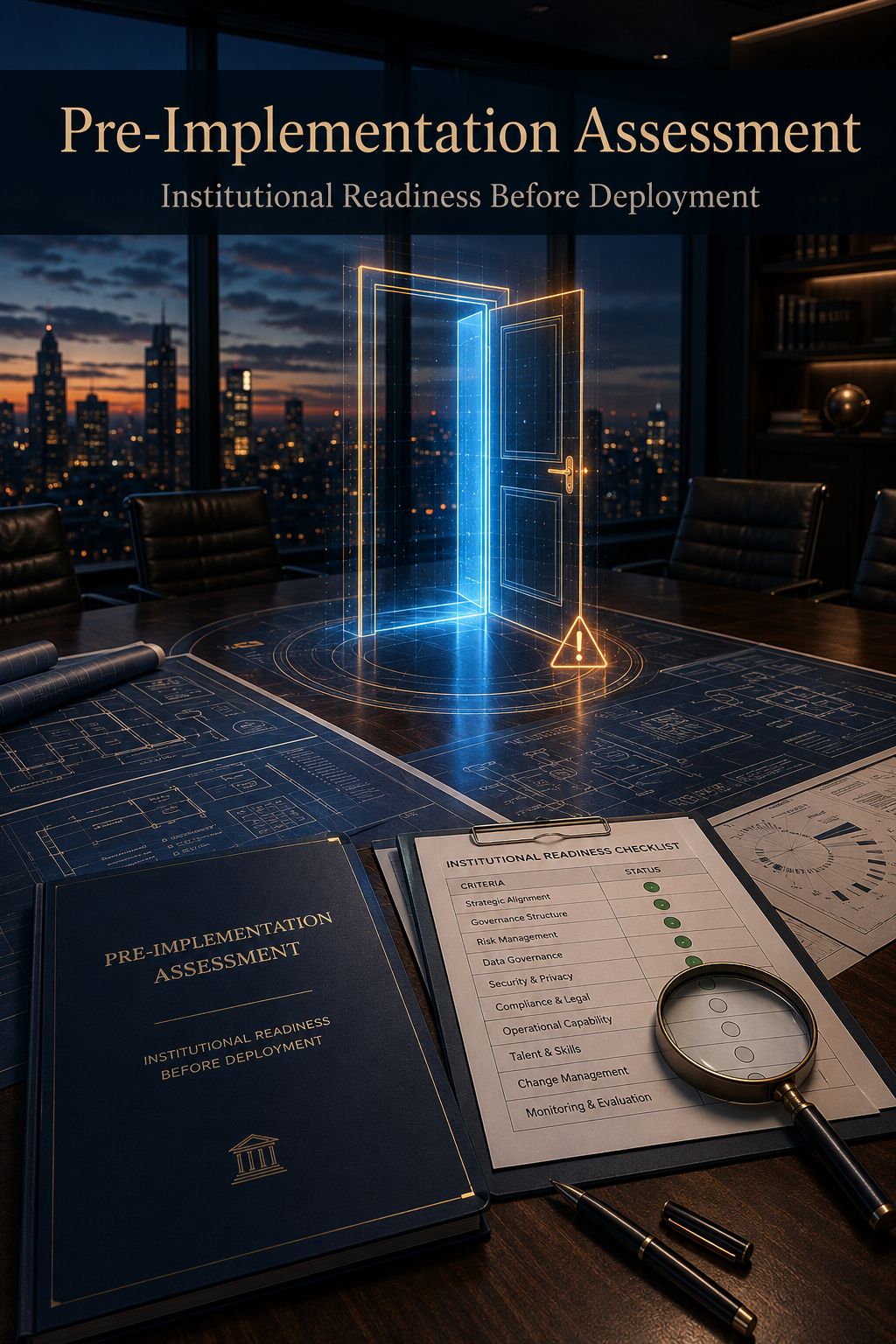
AI Pre-Implementation Readiness Assessment
Diagnostic before the decision — while the organisation retains freedom of action
For organisations facing a decision on AI deployment — regardless of the model: internal development, subsidiary IT structure, external provider or off-the-shelf AI platforms and tools.
Why assess readiness before launch?
Most organisations assess AI risks after deployment — when the system is already running, staff have adapted, and dependency has formed. At that point, changing the control architecture is significantly harder and more costly.
The right moment to assess is before the decision is made. That is when the organisation retains maximum freedom: to choose a deployment model, set contract terms, and establish a control architecture before launch rather than after.
Organisations that conduct a diagnostic before deployment build their control architecture once — to fit their own processes and at their own pace. Those who begin after launch do so under conditions of already-formed dependency.
What the assessment covers
Institutional Readiness
An assessment of whether the organisation possesses the governance structure, competencies and oversight culture necessary for safe AI deployment. Who will make decisions about using the system. Who has the authority to stop it. How oversight will be organised.
Dependency Risks — Across All Deployment Models
An analysis of dependency risks specific to the chosen deployment model: contractual terms with an external provider and exit scenarios; concentration of competencies in the case of internal development; operational dependency on a subsidiary structure; and the less visible risks of adopting off-the-shelf AI tools and platforms. Who bears responsibility if conditions change, key staff leave, or a provider ceases operations.
Control Architecture Over Decisions
An assessment of how human oversight of AI decisions will be structured: who decides to override the system’s decision, on what grounds, with what documentation. What the chain of accountability looks like in the event of an incident. Whether manual operating procedures exist — and whether they will function one year after launch.
Institutional Risk Map
A final document: where risks concentrate, which are critical before launch, what must be addressed in the contract or technical specification. The document can be used for internal approval, briefing the Supervisory Board, or regulatory submission.
Format and deliverables
Duration: 2–3 weeks.
Deliverable: analytical note with readiness assessment and institutional risk map.
The document is suitable for internal approval, Supervisory Board briefing or regulatory submission.
Confidentiality: all materials are shared only with the organisation’s leadership. A Non-Disclosure Agreement (NDA) is available upon request before engagement begins.
Who this is for
- Organisations that have received a proposal from an AI solution provider and want an independent assessment before signing a contract
- Organisations that have decided to create an internal AI team or a subsidiary IT structure
- Organisations that have begun using off-the-shelf AI tools and want to understand the scale of the emerging dependency
- Supervisory Boards and Boards of Management who need to make an informed decision about AI deployment
- Any organisation where the decision on AI deployment has not yet been finalised
Next step
If your organisation is approaching a decision on AI deployment, contact us before it is made. After the system is launched, the options for modifying the control architecture narrow substantially.
Request an assessment: ok@okhodjaev.com | +998 90 352 83 50
All engagements are conducted under a Non-Disclosure Agreement (NDA).