
Visualizing the $117 Trillion World Economy in 2025
Key Takeaways
- The U.S., China, and Germany are the top three countries by GDP in 2025.
- India ranks in fifth, averaging 6.4% in real GDP growth since 2000.
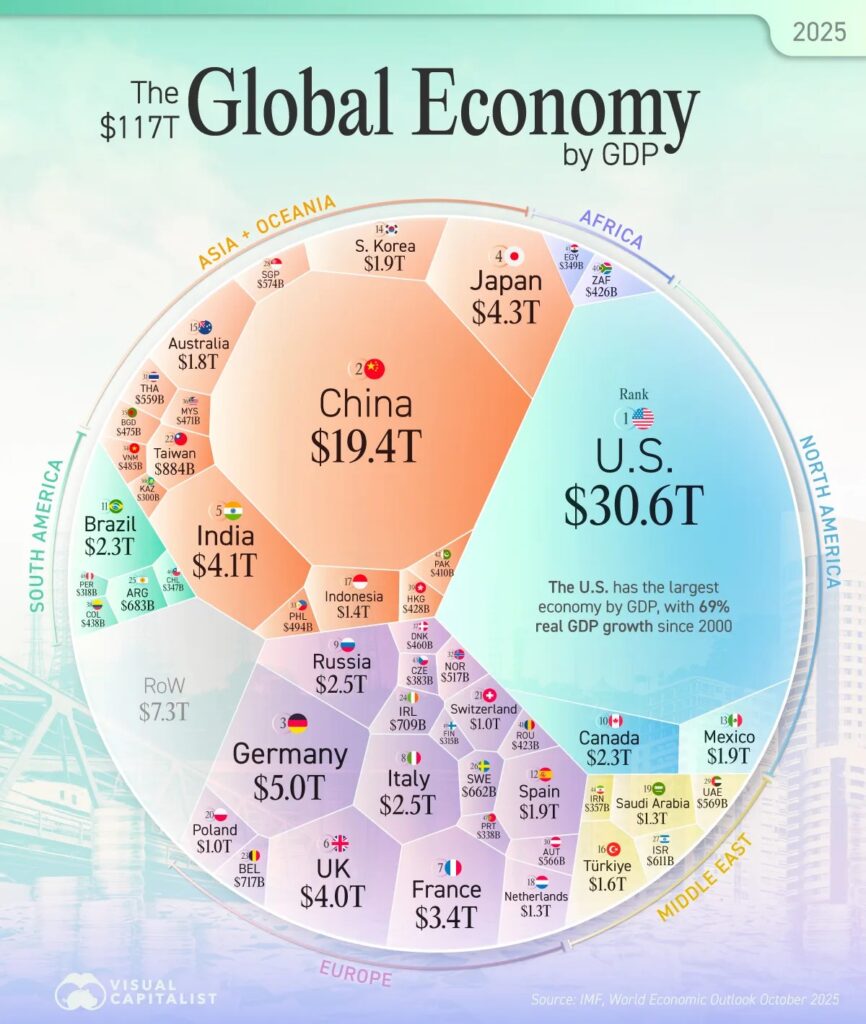
America’s $30.6 trillion economy is greater than China, Germany, and Japan combined, with real GDP set to rise 2% this year.
In comparison, India’s economy is projected to grow 6.6%, among the fastest rates across the world’s largest economies. It is only surpassed by Ireland, as frontloading of exports is expected to expand GDP by a striking 9.1% in 2025.
This graphic shows the state of the world economy in 2025, based on projections from the IMF’s latest World Economic Outlook.
Ranked: The Biggest Countries in the World Economy
Below, we rank the 50 largest economies globally, highlighting their historical growth trends:
|
Rank
|
Country
|
GDP 2025
|
Real GDP
Growth |
2000-2025
Cumulative Real GDP Growth |
2000-2025
Average Annual Real GDP Growth |
|---|---|---|---|---|---|
| 1 | 🇺🇸 U.S. | $30.6T | 2.0% | 69.0% | 2.1% |
| 2 | 🇨🇳 China | $19.4T | 4.8% | 585.7% | 8.0% |
| 3 | 🇩🇪 Germany | $5.0T | 0.2% | 27.8% | 1.0% |
| 4 | 🇯🇵 Japan | $4.3T | 1.1% | 16.6% | 0.6% |
| 5 | 🇮🇳 India | $4.1T | 6.6% | 364.1% | 6.4% |
| 6 | 🇬🇧 UK | $4.0T | 1.3% | 44.6% | 1.5% |
| 7 | 🇫🇷 France | $3.4T | 0.7% | 35.0% | 1.2% |
| 8 | 🇮🇹 Italy | $2.5T | 0.5% | 9.8% | 0.4% |
| 9 | 🇷🇺 Russia | $2.5T | 0.6% | 107.3% | 3.0% |
| 10 | 🇨🇦 Canada | $2.3T | 1.2% | 59.4% | 1.9% |
| 11 | 🇧🇷 Brazil | $2.3T | 2.4% | 75.1% | 2.3% |
| 12 | 🇪🇸 Spain | $1.9T | 2.9% | 50.6% | 1.7% |
| 13 | 🇲🇽 Mexico | $1.9T | 1.0% | 44.4% | 1.5% |
| 14 | 🇰🇷 South Korea | $1.9T | 0.9% | 131.3% | 3.4% |
| 15 | 🇦🇺 Australia | $1.8T | 1.8% | 92.7% | 2.7% |
| 16 | 🇹🇷 Türkiye | $1.6T | 3.5% | 228.3% | 5.0% |
| 17 | 🇮🇩 Indonesia | $1.4T | 4.9% | 233.4% | 4.9% |
| 18 | 🇳🇱 Netherlands | $1.3T | 1.4% | 43.9% | 1.5% |
| 19 | 🇸🇦 Saudi Arabia | $1.3T | 4.0% | 154.1% | 3.9% |
| 20 | 🇵🇱 Poland | $1.0T | 3.2% | 138.5% | 3.6% |
| 21 | 🇨🇭 Switzerland | $1.0T | 0.9% | 54.9% | 1.8% |
| 22 | 🇹🇼 Taiwan | $884B | 3.7% | 144.2% | 3.7% |
| 23 | 🇧🇪 Belgium | $717B | 1.1% | 46.4% | 1.6% |
| 24 | 🇮🇪 Ireland | $709B | 9.1% | 243.3% | 5.2% |
| 25 | 🇦🇷 Argentina | $683B | 4.5% | 54.2% | 1.9% |
| 26 | 🇸🇪 Sweden | $662B | 0.7% | 56.8% | 1.8% |
| 27 | 🇮🇱 Israel | $611B | 2.5% | 132.1% | 3.5% |
| 28 | 🇸🇬 Singapore | $574B | 2.2% | 196.8% | 4.5% |
| 29 | 🇦🇪 UAE | $569B | 4.8% | 155.9% | 3.9% |
| 30 | 🇦🇹 Austria | $566B | 0.3% | 36.0% | 1.3% |
| 31 | 🇹🇭 Thailand | $559B | 2.0% | 116.2% | 3.2% |
| 32 | 🇳🇴 Norway | $517B | 1.2% | 47.5% | 1.6% |
| 33 | 🇵🇭 Philippines | $494B | 5.4% | 234.5% | 5.0% |
| 34 | 🇻🇳 Vietnam | $485B | 6.5% | 372.0% | 6.4% |
| 35 | 🇧🇩 Bangladesh | $475B | 3.8% | 318.5% | 5.9% |
| 36 | 🇲🇾 Malaysia | $471B | 4.5% | 196.2% | 4.5% |
| 37 | 🇩🇰 Denmark | $460B | 1.8% | 40.8% | 1.4% |
| 38 | 🇨🇴 Colombia | $438B | 2.5% | 135.8% | 3.5% |
| 39 | 🇭🇰 Hong Kong SAR | $428B | 2.4% | 92.2% | 2.7% |
| 40 | 🇿🇦 South Africa | $426B | 1.1% | 67.2% | 2.1% |
| 41 | 🇷🇴 Romania | $423B | 1.0% | 134.4% | 3.5% |
| 42 | 🇵🇰 Pakistan | $410B | 2.7% | 158.7% | 3.9% |
| 43 | 🇨🇿 Czechia | $383B | 2.3% | 77.0% | 2.4% |
| 44 | 🇮🇷 Iran | $357B | 0.6% | 110.2% | 3.1% |
| 45 | 🇪🇬 Egypt | $349B | 4.3% | 185.5% | 4.3% |
| 46 | 🇨🇱 Chile | $347B | 2.5% | 125.5% | 3.4% |
| 47 | 🇵🇹 Portugal | $338B | 1.9% | 26.3% | 1.0% |
| 48 | 🇵🇪 Peru | $318B | 2.9% | 170.7% | 4.2% |
| 49 | 🇫🇮 Finland | $315B | 0.5% | 30.4% | 1.1% |
| 50 | 🇰🇿 Kazakhstan | $300B | 5.9% | 288.2% | 5.6% |
As we can see, the U.S. economy has grown nearly 70% in the past quarter-century, in inflation-adjusted terms. On an annual basis, the average growth rate was 2.1%, the third-fastest across the 10 largest economies today.
For perspective, India has grown at more than triple this rate over the last 25 years, helping grow its GDP to $4.1 trillion. By next year, it is forecast to surpass Japan as the fourth-biggest economy.
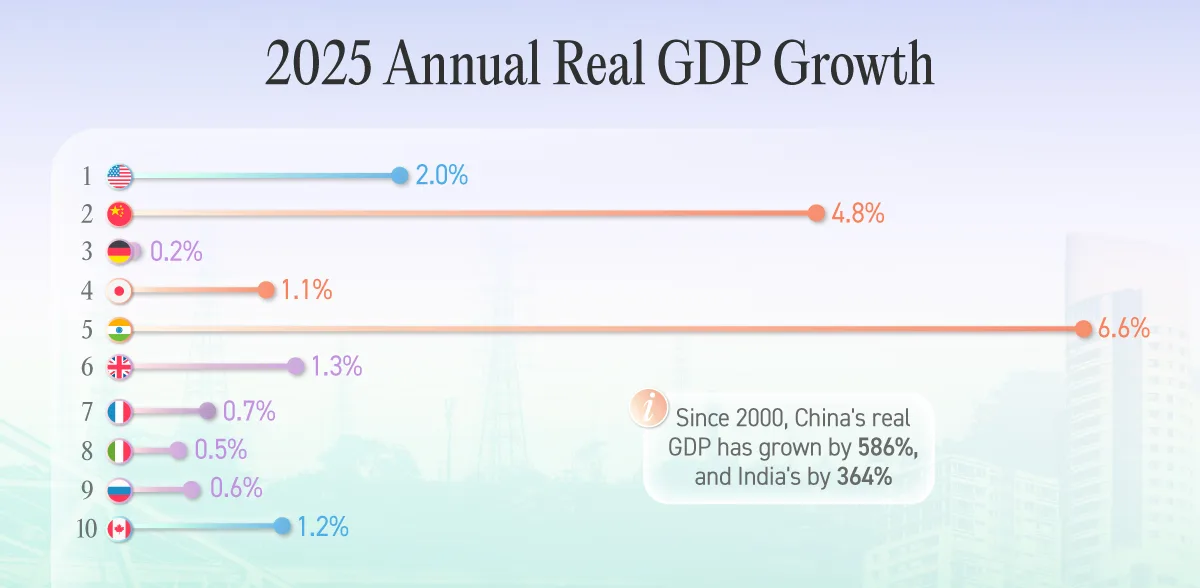
Germany, on the other hand, has seen notably sluggish growth for decades. In both 2023 and 2024, the economy contracted, while growth is expected to be just 0.2% this year. Along with weak productivity growth, its manufacturing sector has been in decline since 2018.
Similarly many European countries have averaged less than 2% growth over the last 25 years. Italy, the eighth-biggest economy, has averaged just 0.4% GDP growth, while in France, it has been just 1.2%.
Source: Visual Capitalist